Family Expands Through Genealogy Research (Part 4)

Maryland Archives: A State Treasure

By Jackie Nickel

Several weeks ago when I received a call from a member of the Roth family of Essex suggesting that I might be their distant cousin, I had not the slightest interest in genealogy. Now, thanks to their encouragement and careful coaching, I’m hooked. For me, it’s not so much documenting generat ions of ancestry, but putting together pieces of my grandparents’ lives and, importantly, finding the burial place of my great grandmother. My research so far has been like dogged detective work, scraping from public records and comparing notes with other family members. It’s been far from scientific and some of what I have found has been pure luck.

Last week, after a couple of false starts, I finally got to visit the Maryland State Archives in Annapolis. The drive is an easy one, across the Key Bridge to Route 97 and over to Route 50, the Rowe Blvd. exit. The beautiful building is on your left on Rowe Blvd., a few blocks before the State House, across from the stadium. There’s no big sign, just “Maryland State Archives” carved in the concrete above the door. Inside are all kinds of records imaginable: birth and death, marriage, military, naturalization, tax lists, land records, census, probate and much more.

Like the Maryland Historical Society, you must sign in and check your purse before you enter to ensure no one smuggles out valuable documents. You are assigned a locker and given the key on chain with a tag indicating your desk number. That desk will serve as your base of operations. as you roam the archives. Although the personnel is friendly and helpful, don’t expect them to be able to spend too much time with you. They are very busy retrieving documents and showing patrons how to use viewers and copiers. During my visit, they spent as much time as they could trying to unjam a file cabinet drawer for me but to no avail. But they will lead you in the right direction to find what you seek.

I was looking for death records and hoping to get a copy of my great grandmother’s death certificate, including notation of the cemetery where she was interred. I had narrowed down the time of her death to between 1910 and 1914 so I asked for Baltimore City death records for those years and was shown to the proper microfilm drawer. Once I got the hang of the projection machine I reeled swiftly through the records which are listed alphabetically by year. No Mary Nickel. I went back through them again but still no luck. I then remembered what one of my new-found cousins told me, that most of Highlandtown and Canton was considered Baltimore County early in the century, so I found the county death index in another drawer and got to work. Work it was.

The county deaths were recorded on little cards, not lists like the city’s. The microfilm of those cards read like inkblots, blurred to the point of distortion. I strained my eyes until I had a headache, guessing which names began with N. It was impossible. I put the film back in the tray for the attendants to file and walked around the library. It is the most beautiful room, with exposed brick walls and natural light filtering in from an open balcony. A baby grand piano seems suspended on a platform above the service desk and I can just imagine the wonderful government receptions held in that room.

I watched other patrons put in request slips for old volumes of information at the desk then wait at their own assigned desks for delivery. Some of the books were wrapped in parchment paper and seemed to be hundreds of years old. One can only imagine the history within those pages. I couldn’t help but think that this new archives facility is a great and wise use of taxpayers’ money. But it seemed my mission there would not be accomplished on this particular November day.

As I mentioned my discouragement to another visitor and described the trouble I had deciphering the county death cards, she advised me to try reading them on a viewer in another part of the room. The machines there are newer and brighter, she said. So in a last ditch attempt, I retrieved the film once again and began reeling and scanning. In 1911, I could just about differentiate the “Ns”. I could even make out the name Nicodemus, so I scrolled back to where I judged Nickel might be, looking for anything with the vague shape of the name or with six letters. Only one was a possibility and I strained my eyes to try to make “Mary Nickel” out of it. I sighed and leaned back in my chair and as I put distance between myself and the machine, the words seemed to take shape. It was Mary Nickel and the date underneath was Sept. 9, 1911, I figured out after more scrutiny.
I was overjoyed and dashed to the service desk to put in a request for a copy of the death certificate to be taken from the original on file (you can make your own copy from the microfilm version if you wish). The attendant asked me to wait at my desk. After what seemed like hours but was actually only about 15 minutes, he walked over to me with a folder. Inside was a copy of a death certificate which might or might not be my great grandmother’s. I nervously opened it and smiled when I saw the place of death was the address on S. Clinton St. where I knew she had lived. Her maiden name was there and the cause of her death, some kind of heart ailment; she was just 67. A tear or two trickled down my cheek as I realized she was just ten years older than I when she died. The name of the undertaker who removed her body, however, brought a smile: John Digman. How appropriate. He removed her body to an address on Eastern Ave. across from Patterson Park that I later found out (thanks to the nice people at Sacred Heart of Jesus Cemetery) was a Polish funeral home, Fialkowski’s. But the name of her burial place was not noted. I sighed again, and committed to a cemetery by cemetery search.

Death certificate in hand I headed home, promising to come back again to enjoy the surroundings and dig in another area of family history. For the next several days I called and visited a lot of cemeteries where my Mary Nickel could be buried. I started with the Catholic ones on German Hill Rd., then the Lutheran ones and finally Baltimore Cemetery and others in the city. No Mary Nickel. Some caretakers and personnel were very nice and helpful, a few acted like they didn’t want to be bothered and told me to send a written request. I even called the Maryland Funeral Directors Assn. to find out where the Fialkowski funeral home records are kept. No reply to date. And still no Mary Nickel. But I know I’m very close to finding her and when I do it will be with armfuls of Christmas flowers for her grave.
NEXT: Family Expands Through Genealogy Research (Part 5)

Family Expands Through Genealogy Research (Part 5)

The Final Resting Place

By Jackie Nickel

What started out as a brief story about my phone call from a distant relative has resulted in a five-part series on the search for my great grandmother Mary Nickel’s grave. Last episode I wrote about finding her death certificate in the state archives but being unable to discover the cemetery where she was buried. That segment brought a few more helpful phone calls and emails that led me to the Enoch Pratt Free Library’s main branch on Cathedral St. last week. Mission: To view microfilm from the Sunpapers’ archives and find my great grandmom’s obituary which would list her interment site.

I found a parking spot at a meter right in front of the library a week ago Tuesday, however there was a half hour limit. Never mind, I’ll work fast I thought depositing two quarters. Through the revolving doors, my first stop was the information desk, but on my way I had to slow down and admire the beautiful architecture inside and out. I hadn’t been to the Pratt since I did a 100th anniversary history book for Our Lady of Mt. Carmel Church over a dozen years ago.

Five minutes was used up on the parking meter before I was directed to the Periodical area where old newspaper information is stored. A gentleman there showed me to the proper drawer where the early 1900’s Sun microfilm is stored. I found the 1911 (the year Mary died) reel and hurried to a viewer only to fumble the thread of the microfilm. Rats! I had to ask for help. The library assistant was busy with another patron and I had to wait a few minutes before she came over to thread the machine. Twenty minutes to go on the meter.

I quickly found the Sept. 9 (the date she died) issue and proceeded to scroll through the next day’s pages, figuring her obituary would get in a day or two after her death. The front page was pretty interesting with ads for local vaudeville theaters running down the left hand side so I looked to see if any of the ones my grandfather had owned were listed. He ran the Monumental and Folly for a while before he bought the Gayety and I was happy to see the Monumental advertised. On to other pages, but not so fast. As a 20-year local newspaper veteran, I couldn’t help but notice the informal writing style which graced the aged pages. There seemed to be little attempt to hide editorialization in news stories but the inside features were on the verge of scandalous! One article informed readers how Ms. So and So, who was seeing a prominent widower, was snubbed at a public function by his deceased wife’s friends. The Society pages even described details of the ladies’ outfits and menus presented at each social event. Here and there among the articles were a couple obituaries so it seemed they were not all grouped together in the back of the paper as they are today.

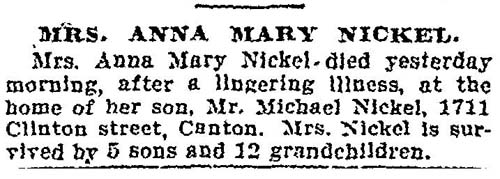
No luck on Sept. 10, 11, 12, or 13th, so I was getting discouraged while also looking at my watch and thinking I should go outside and feed the meter. Reluctantly I started rewinding the reel but as I got back to Sept. 10 something made me slow down a bit. Right there in front of my eyes was a list of about eight obituaries and smack dab in the middle was the last name NICKEL. Just like all my other discoveries, it was divine providence I felt, squinting to get a close look at the screen. My great granny was listed as Anna Mary, not Mary A. as on her death certificate, but that was probably just a slip-up of the typesetter I thought as my journalistic mentality kicked into gear. She died at the home of her son John H., my grandfather, on S. Clinton St. and was “laid out” at the home of her other son John (there were two Johns and two Georges, remember) on Eastern Ave. A Requiem High Mass was to be celebrated at Sacred Heart of Jesus Church the next day, followed by burial at Holy Redeemer Cemetery at Belair and Moravia Rds.

I was so elated to find the info I’d been seeking! I quickly hit the button to print a copy of the obituary, rushed to the desk to pay my 21¢ (here’s a quarter, keep the change) and ran to the car just as the “violation” sign popped up on the parking meter. Back home I called the helpful folks at Sacred Heart of Jesus cemetery and lucky for me, they had possession of the Holy Redeemer records as well. A search for Mary Nickel’s grave location in Holy Redeemer, however, yielded nothing.

Oh no, I thought, it must be there. Maybe it was spelled wrong while being transcribed from handwritten records to the computer. There was, however, a Nickel gravesite with four interments listed: John, Anna, a baby Martha, and John Jr. This could be Mary’s second son John (for some reason he was known in the family as Noodle Soup John) and his wife Annie. But where was my Mary? The lady at SHJ said there were five graves in the lot. But only four were accounted for. Could my Mary be in the fifth and her records were lost?

I asked the location of the grave inside Holy Redeemer cemetery, which I’d never visited before. I had no idea how big it was. The SHJ lady described to me where the Nickel lot was in relation to the chapel and mausoleum and told me there was a headstone with the last name engraved. Maybe there were five first names instead of four on the stone, I thought.

By that time it was 3:30 p.m. and the sky was gloomy. Should I go to the cemetery now or wait ‘til tomorrow? It’s not in a very good area of the city, I mused, but that’s OK, I’ll take Sammy with me for protection. Off we went, my dog and I to a strange graveyard in quickly falling dusk. It was 4 o’clock by the time we drove through the narrow gatehouse. “Gates closed at 4:30” the sign said. I hurried up the hill toward the chapel and parked the car, leaving Sam inside. I walked up and around the mausoleum checking gravestones and dodging holes in the ground. It was a nice old cemetery but the terrain left a lot to be desired. As I stumbled on a rock and slipped in a swale I feared for a moment the ground might swallow me up. For the first time in my exploration I was scared.

There seemed to be no one else in the cemetery and I anxiously peered toward the gate. Suppose the caretaker came by and locked it, not knowing I was inside? I was almost too nervous to look for names and besides, some were so worn you could barely read them. Sam was watching me closely from the car and I dare not wander too far. It was 4:20 and getting darker by the minute. I was weaving frantically among the granite and limestone and slipping and sliding on the wet leaves scanning engraved names. I have to leave now, I told myself turning to go. And as providence would have it, there it was, NICKEL in gray granite about 20 feet away.

I rushed over and stood there staring at the names: John, Anna, Martha, John Jr. No Mary. I stood very still hoping to feel some vibes that she was actually under that earth and her name was somehow unintentionally omitted from the stone. I concentrated real hard, the wheels of my mind swiftly processing all the information I’d collected over the past two months. And I came to a conclusion: I think her body is laid to rest there in that lot. Mary would have been the first one to be buried there. Noodle Soup John and his wife died over 20 years later and that’s when the tombstone was erected I deduced by its design. Someone might have forgotten Mary was buried there.

So now, I thought, at least until I find out otherwise, I’ll have a grave on which to place my great grandmother’s Christmas flowers. I walked back to the car deep in meditation, oblivious to Sammy’s yapping and the encroaching darkness. I glided out of the gatehouse just as a woman carrying a big ring of keys was walking in.

Photo by Jackie Nickel The Roth family of Essex, the distant cousins who discovered our familial relationship, called and got me hooked on family history: Patti Roth Parker, Eleanor Roth and Kathy Roth Head. We recently met up at Schwartz’s Cemetery on O’Donnell St. where some of our mutual family is buried. The Roth ladies visit over a dozen cemeteries during the holiday season, placing flowers on the graves of 38 deceased relatives, many of whom they discovered during 22 years of genealogy research.

***POSTSCRIPT: After visiting the cemetery office a few weeks later, I found out my great grandmother Mary Nickel actually was buried in another grave site nearby the one described above. Four others are buried in the plot, all with the last name “Scherbel”. Another mystery evolves. Who were the Scherbels? Why was my great grandmother buried in their plot? An Anna Scherbel had died the year before my Mary at age 50 and that’s when the Holy Redeemer plot was purchased — for $50! The most comforting aspect of the discovery was the large Scherbel monument. Although the four Scherbel family members and the dates of their death were engraved in the granite, Mary Nickel’s name was not on the marker. But atop the tall gravestone is a large statue of the Blessed Virgin — Mary. On Christmas Eve 2000, I placed flowers there.

PPS: In July 2002, I reread some notes written by my mom shortly before she died in 1995. There she had written the names of Nickel ancestors, including her father’s sister Anna… who married a man named Scherbel! I’m now comforted in knowing that “my Mary” is buried alongside her daughter.


Burlesque and the Girl on the Sign at the Gayety Theater

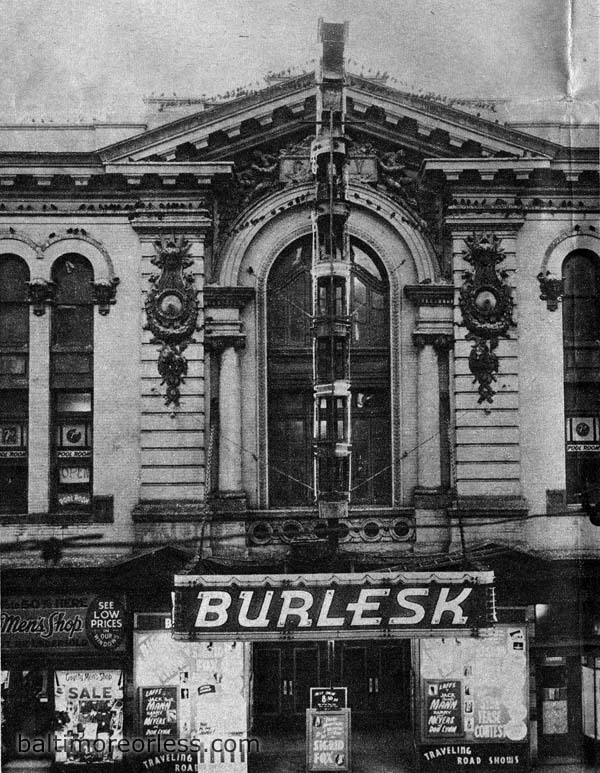
Gayety Theater at Baltimore and Frederick Streets, as it appeared in its heyday. Perennial birds, which sometimes short-circuited marquee, can be seen on roof.

I Remember… Burlesque and the Girl on the Sign at the Gayety Theater

By John H. Nickel, The Sun Magazine, 5/31/1970

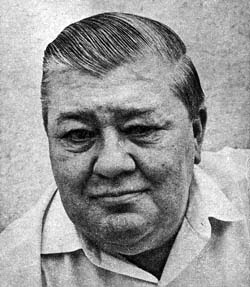
"Bud" Nickel - Jackie's uncle

I don’t have much heart to go down to The Block anymore. The flavor of it has been gone for me since the Gayety Theater burned on the first day of Christmas week.

I drop by now and then to see my friends. But the spirit of that whole section seemed to die when the kicking girl — our animated neon sign which was almost four stories high — quit kicking.

The baggy pants comedians and the pretty girls still put on a sort of the old Gayety type burlesque in a smaller theater nearby, but there isn’t much stage room there for them to really give out, and the stripteasers are taking it all off to phonograph music, with a drummer sitting in to accentuate the bumps and grinds.

For 60 years the Gayety brought to Baltimore this country’s finest burlesque talents — strippers like Ann Corio, Margie Hart, Hinda Wassau, Blaze Starr, Valerie Parks, the Carroll Sisters, and such funny men as Phil Silvers, Jackie Gleason, Joe Penner, Rags Ragland, Red Skelton, Billy Hagen, Hap Hyatt, Billy Boob Reed. It was known all over the world, its fame spread throughout World War II by practically every soldier, sailor and Marine who ever did a week on the town in Baltimore.

United States senators, diplomats, admirals and generals have sat among the Gayety’s patrons. Easily 30 percent of the clientele were women.

My father, John Nickel, made the Gayety what it was.

He had come to Baltimore around 1898 when his mother brought her family of four sons and a daughter over from Germany. My father had been christened Johann, and although he changed his name to John on this side, his friends called him “Hon” all his life.

His mother bought several acres on Colgate Creek, near the site of the old Riverview Park, and for some time operated a dairy farm. But my father, despite his lack of education, had another life in mind for himself. He was a terrific promoter, and as a young man somehow came into possession of the Natpins, a small hotel (later to become the Commercial) at Baltimore and Frederick Streets.

This was an inexpensive place much patronized by traveling theatrical troupes, and here my father learned that he loved show people. He had the reputation of never turning away down and outers, and his attitude won him many lifelong friends among performers.

In 1910 what was to become the Gayety was broke, in the hands of the receivers. My father bought it with not much more than a handshake. He had practically no money, but he had the infectious ability to promote. I strongly suspect that one thing which helped him operate in the early years, when money was so scarce, was the loyalty of his show people friends.

I was born in 1918, and was running errands and making myself useful around the theater when I was a grade schooler. Show people there gave me the name of “Bud .” When I finished school at Calvert Hall, I went right to work, selling tickets. Before long I began helping my father book the acts, and I learned the business that way.

We had the best burlesque in the country. We booked mostly through the Hirst Circuit, out of New York. The Wheel, as show people called it, took in Baltimore, Washington, Norfolk, Pittsburgh , Boston, Youngstown, Scranton, Allentown, Cleveland, mostly one-week runs, with one and two-night stands at smaller towns along the route.

A thousand people filled the Gayety — orchestra seats, balcony and boxes — and we sold out quite often. When Ann Corio came to town we turned away customers. She was a big enough draw that she could demand her own terms, which often amounted to $1,200 plus a house percentage which boosted her to $2,000 a week — big money now, and much bigger in the 1930’s and 1940’s.

A show ran about 2 ½ hours. There was a star stripper, a No. 2 and often a No. 3 stripper, and three minor take-it-off performers. There’d be a big name comedy team, possibly one or two other comics working alone. There was a house singer, who did two numbers each show, usually as accompaniment for a costume number staged by the traveling chorus of 12 showgirls.

Practically every rainy day and clear night meant good business. On rainy days the theater would be packed with customers whose work was hampered by bad weather, mostly salesmen. There was continuous entertainment from noon to 5 P.M., 8.30 to 11 P.M. The place was open seven days a week, and it closed only during the hot spell from late May to early September, for it had no air conditioning.

The Gayety nightclub opened shortly after the theater, and it ran until Repeal on soft drinks and near beer. At the end of Prohibition it became a great deal more profitable business, much of it from theater patrons. We had a ladies’ wash room in the theater, but the men’ s room was downstairs in the night club. Most of the gentlemen who went down there stayed over for the floor show, more burlesque entertainment.

After my father died in 1950, I ran both the theater and the club for a while with my sister, Mrs. Marian Nickel McKew. Later we leased out the theater and spent our full time managing the club.

But the big old burlesque house was our first love. What a pain in the neck the big animated neon kicking girl sign was. Pigeons and starlings picked it as a roosting spot because they liked the warmth of all the lights. The mess they created was forever short-circuiting the wiring in the sign. But, because it was a landmark known around the world, we never thought of replacing it.

Like many other Baltimoreans, I miss the kicking girl. I don’t think The Block will ever be the same without her.